Evaluating the Set of Cursor Arrows in 3D Style for Digital Interface Design
In the evolving landscape of user interface design, the cursor remains one of the most fundamental yet frequently overlooked elements of interaction. While standard system cursors provide functionality, they often lack the visual cohesion required for immersive digital experiences. The Set of Cursor Arrows in 3D Style for Dig represents a specific approach to solving this problem by offering depth, dimensionality, and a tactile quality that flat icons cannot achieve. For designers, developers, and creative directors aged 20 to 50 who are tasked with refining web applications or software interfaces, understanding the utility and limitations of such assets is crucial for making informed resource decisions.
This collection is not merely a set of images; it is a toolkit designed to bridge the gap between two-dimensional screens and three-dimensional perception. By analyzing what makes this specific set distinct, how it compares to traditional alternatives, and when it fits best within a project's scope, professionals can determine if these assets align with their technical requirements and aesthetic goals.
Defining the Distinctive Value of 3D Cursor Assets
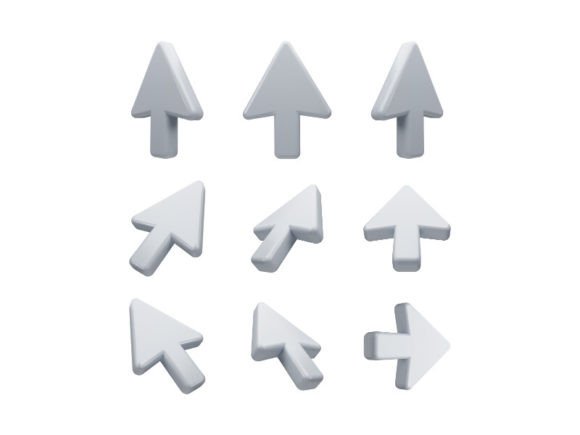
The primary distinction of the Set of Cursor Arrows in 3D Style for Dig lies in its rendering technique. Unlike vector-based flat designs that rely on solid colors and simple gradients, these arrows utilize shading, highlights, and perspective to simulate physical volume. This creates a sense of hierarchy and presence that draws the eye more effectively than a standard white pointer. In an era where users interact with complex dashboards, e-commerce platforms, and multimedia applications, a cursor that feels "real" can subtly enhance the perceived quality of the entire interface.
What sets this collection apart is the balance between stylization and usability. A common pitfall in 3D iconography is over-complication, where excessive detail obscures the function of the tool. This set avoids that trap by maintaining clear silhouettes while adding depth through lighting effects. The result is an arrow that is instantly recognizable as a selection tool but stands out against busy backgrounds. Furthermore, the inclusion of high-resolution formats ensures that these assets remain crisp across various display densities, from standard monitors to high-DPI retina screens.
Comparing Formats: JPG Versus EPS for Workflow Integration
A critical factor in evaluating any graphic asset package is the file format provided. The Set of Cursor Arrows in 3D Style for Dig includes both JPG files at 300 dpi (3000 pixels) and an editable Eps 10 file. Understanding the tradeoffs between these formats is essential for different stages of the design process.
- JPG Files (300 dpi, 3000 pixels): These rasterized images are ideal for immediate implementation in web projects where vector editing is unnecessary. The 300 dpi resolution ensures that the image retains sharpness even when printed or viewed on high-resolution displays. For front-end developers integrating assets into HTML/CSS or JavaScript environments, these files offer a plug-and-play solution without the need for conversion tools.
- Eps 10 (Editable): The Encapsulated PostScript format provides significant flexibility for designers using vector software like Adobe Illustrator. Having an editable version allows for customization of colors, scaling without loss of quality, and modification of the 3D parameters to match specific brand guidelines. This is particularly valuable for agencies that need to adapt assets for multiple clients or rebranding campaigns.
When comparing this dual-format approach to resources that offer only PNGs or SVGs, the inclusion of EPS adds a layer of professional utility. However, it is worth noting that while SVG is the industry standard for scalable web graphics, EPS is primarily a print and design workflow format. Users must be prepared to convert the EPS to SVG if they require strict web scalability, whereas the JPGs serve well for fixed-size implementations or mockups.
Contextual Fit: When 3D Cursors Enhance User Experience
Not every digital interface benefits from a 3D cursor. The decision to use the Set of Cursor Arrows in 3D Style for Dig should be driven by the overall design language of the application. In minimalist, content-heavy websites such as news portals or academic journals, a highly stylized 3D cursor might distract from the text and reduce readability. In these scenarios, a subtle, flat system default is often the superior choice.
Conversely, there are specific contexts where these 3D assets shine:
- Gaming and Interactive Entertainment: Interfaces that already employ 3D graphics, isometric views, or skeuomorphic elements benefit greatly from a cursor that matches the environment. The depth of the arrow reinforces the immersive nature of the experience.
- Portfolio and Creative Agency Sites: For designers showcasing work, the cursor acts as a signature element. A unique 3D arrow can signal attention to detail and a commitment to visual excellence.
- High-End E-Commerce: Luxury brands often use rich textures and lighting in their product imagery. A 3D cursor complements this aesthetic, creating a cohesive journey from browsing to purchasing.
- Software Dashboards with Complex Data: In applications where data visualization involves charts and graphs, a 3D cursor can help distinguish interactive elements from static background information, guiding the user's focus more effectively.
The key is consistency. If the rest of the interface uses flat buttons and monochromatic palettes, introducing a 3D cursor may feel disjointed. The asset works best when it is part of a broader design strategy that embraces dimensionality.
Tradeoffs and Limitations to Consider
While the Set of Cursor Arrows in 3D Style for Dig offers significant aesthetic advantages, it is not without limitations. One primary consideration is performance. Rasterized cursors, especially those saved as high-resolution JPGs, can be larger in file size compared to simple vector shapes. In bandwidth-constrained environments or mobile-first applications, loading large cursor images could marginally impact load times, although modern caching strategies usually mitigate this issue.
Another limitation is accessibility. Users with visual impairments or cognitive processing differences may find highly stylized cursors harder to track than standard, high-contrast system pointers. Designers must ensure that the 3D effect does not compromise the visibility of the cursor against all possible background colors. Additionally, some operating systems or browsers may have restrictions on custom cursor sizes or formats, requiring fallback mechanisms to ensure cross-platform compatibility.
From a maintenance perspective, relying on external assets means that updates to the design system require managing these specific files. If a brand refresh occurs, the designer must return to the EPS file to adjust the colors or style, rather than simply changing a CSS variable. This adds a step to the workflow that is absent when using purely code-based cursor definitions.
Decision Factors for Selecting the Right Resource
When deciding whether to integrate the Set of Cursor Arrows in 3D Style for Dig into a project, professionals should evaluate several key factors. First, assess the existing visual identity. Does the project already utilize shadows, gradients, and depth? If so, this set will likely integrate seamlessly. Second, consider the target audience. Are they tech-savvy users expecting a polished, modern interface, or are they looking for quick, utilitarian access to information?
Third, evaluate the technical constraints. Does the development team have the capacity to handle raster assets and potential format conversions? The inclusion of the editable EPS file suggests a workflow that values customization, which may appeal to design-led teams but add complexity for lean development squads. Finally, weigh the cost of implementation against the value of differentiation. In a crowded digital market, small details like a custom 3D cursor can contribute to a unique brand identity, but they must be weighed against the risk of alienating users who prefer standard conventions.
Practical Implementation Strategies
For those who decide that this set is the right fit, successful implementation requires careful planning. Start by testing the JPG files in the actual browser environment to ensure the 3000-pixel resolution scales correctly to the typical cursor dimensions (usually around 32x32 or 64x64 pixels). Because the source file is large, cropping and resizing in a vector editor before export can optimize the final output for web delivery.
Utilize the EPS file to create variations. For example, you might generate a dark-mode version of the arrow by adjusting the lighting and shadow properties to suit low-light interfaces. This level of customization ensures that the cursor remains visible and aesthetically pleasing regardless of the theme. Additionally, consider pairing the 3D cursor with other interactive states, such as hover effects or click animations, to fully leverage the dimensional aspect of the design.
Ultimately, the Set of Cursor Arrows in 3D Style for Dig serves as a powerful tool for elevating digital interfaces, provided it is used with intention and awareness of its context. It offers a middle ground between the rigidity of system defaults and the complexity of fully custom-coded interactions. By understanding its strengths, format capabilities, and appropriate use cases, designers can make a balanced decision that enhances user engagement without compromising functionality.