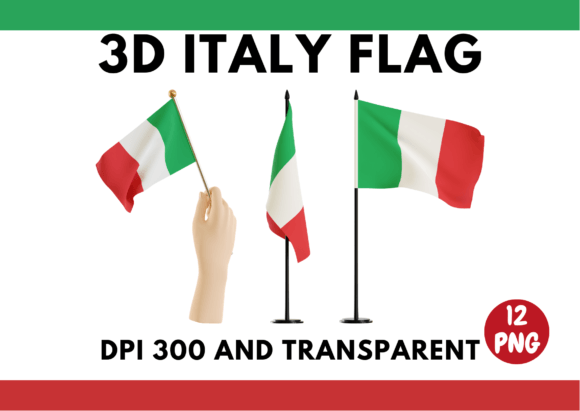
3D Render Italy Flag: A Practical Guide to High-Quality Digital Assets
In the landscape of digital design, the choice of visual assets often dictates the perceived quality of a project. When representing national identity, particularly for a country with such a rich cultural and historical presence as Italy, the standard flat vector or low-resolution photograph may no longer suffice for modern applications. The 3D Render Italy Flag has emerged as a sophisticated alternative, offering depth, texture, and lighting effects that static images cannot replicate. For designers, marketers, and content creators aged 20 to 50 who are evaluating resources for greeting cards, social media elements, video content, or advertising headers, understanding the nuances of this specific file type is essential for making an informed decision.
This article explores what defines a high-quality 3D render of the Italian flag, how it compares to traditional formats, and when it is the most appropriate tool for your creative workflow. By examining the technical specifications, use cases, and trade-offs, you can determine if this asset aligns with your project requirements without relying on marketing hype.
Defining the 3D Render Italy Flag Asset
A 3D Render Italy Flag is not merely a photograph of a physical flag or a two-dimensional illustration. It is a computer-generated image created using three-dimensional modeling software. This process involves constructing a virtual model of the flag, applying realistic materials to simulate fabric textures like cotton or polyester, and then rendering the scene with complex lighting engines. The result is an image that captures the way light interacts with the folds, ripples, and edges of the tricolor—green, white, and red—with a level of realism that is difficult to achieve through photography alone.
The distinct value of this asset lies in its flexibility and clarity. Unlike a photograph, which is bound by the conditions under which it was taken (weather, angle, background), a 3D render allows for perfect control over every element. The specification files typically associated with these assets, such as the PNG File Type Cutout Image, ensure that the background is transparent. This transparency is crucial for integration into various design layouts, allowing the flag to sit naturally atop other graphical elements without the need for time-consuming manual masking or erasing.
Furthermore, the "No Watermarks" aspect mentioned in high-quality listings is a critical differentiator. In professional workflows, watermarks obscure the final output and limit commercial usability. A clean, unbranded file ensures that the integrity of the design remains intact, whether it is being used for a corporate advertisement or a personal invitation header.
Comparing 3D Renders with Traditional Formats
When evaluating options for representing the Italian flag, designers typically weigh three primary categories: flat vectors, stock photography, and 3D renders. Each format serves a specific purpose, and the "best" choice depends entirely on the context of the project.
Flat Vectors: Vector graphics are resolution-independent and ideal for print materials requiring sharp lines at any scale, such as business cards or large banners. However, they lack depth. A flat vector of the Italy flag will appear as three solid bands of color. While efficient, it can feel sterile or generic in contexts where emotional resonance or realism is desired.
Stock Photography: Photographs offer authenticity but come with significant limitations. Finding a photo of the Italian flag with a perfectly neutral background is rare. Most require extensive editing to remove the sky, buildings, or poles behind the flag. Additionally, lighting conditions in photos can be unpredictable, leading to shadows or color casts that may clash with your brand palette. Resolution is also a concern; zooming in on a stock photo often reveals pixelation.
3D Renders: The 3D Render Italy Flag bridges the gap between the scalability of vectors and the realism of photography. It provides the texture and lighting of a photo but with the clean isolation of a vector cutout. Because the background is digitally generated as transparent from the start, there are no jagged edges or leftover pixels. This makes it superior for compositing into complex scenes, such as video overlays or layered social media graphics.
Key Differences in Workflow Efficiency
- Editing Time: Using a pre-rendered PNG cutout saves hours compared to manually masking a photograph.
- Consistency: 3D renders allow for consistent lighting across multiple assets, whereas mixing photos taken at different times can create visual dissonance.
- Versatility: A single high-resolution render can be resized for both web thumbnails and large-format posters without losing detail, provided the source resolution is sufficient.
Evaluating Strengths and Trade-offs
While the 3D Render Italy Flag offers compelling advantages, it is important to approach the selection with a balanced perspective. Understanding the trade-offs ensures that the asset fits the specific needs of your campaign or design.
Strengths:
The primary strength is visual impact. The interplay of light and shadow on the fabric creates a sense of movement and life, even in a static image. This is particularly effective for Greeting Card designs or Invitation Headers where the goal is to evoke pride or celebration. The transparency of the PNG format ensures seamless integration into Social Media Element Content, allowing the flag to float naturally over profile pictures, text blocks, or promotional backgrounds. Furthermore, for Video Element Content, these assets can be animated easily in post-production software, adding a dynamic waving effect that feels organic rather than mechanical.
Trade-offs and Limitations:
One consideration is file size. High-fidelity 3D renders with detailed textures and transparency channels can result in larger file sizes compared to simple vectors. For extremely bandwidth-constrained environments, such as certain mobile web applications, optimization may be required. Additionally, while 3D renders look realistic, they are still synthetic. In contexts demanding absolute documentary authenticity—such as a news report about a specific event—a real photograph might be more appropriate than a stylized render.
Another factor is the artistic style. Not all projects benefit from hyper-realism. If a brand's aesthetic is minimalist or abstract, a highly detailed 3D flag might feel out of place. In such cases, a simplified vector or a flat icon might communicate the message more effectively.
Determining the Best-Fit Situations
Deciding whether to utilize a 3D Render Italy Flag comes down to the intended application and the desired emotional response from the audience.
When to Choose a 3D Render:
- High-Impact Marketing: For Advertisements and Posters where capturing attention is paramount, the depth and texture of a 3D render make the imagery pop off the screen or page.
- Complex Composites: When creating Video Element Content or layered social media posts, the transparent background eliminates the headache of background removal, ensuring a professional finish.
- Celebratory Occasions: For Invitations or Greeting Cards related to Italian heritage, holidays, or sports events, the realistic fabric texture adds a touch of elegance and gravitas.
- Web Design: On websites where the flag needs to blend seamlessly with modern UI elements, the clean edges of a PNG cutout provide a polished look.
When to Consider Alternatives:
- Minimalist Branding: If your design system relies on flat colors and geometric shapes, a 3D render may introduce unnecessary visual noise.
- Journalistic Contexts: News outlets or educational materials focusing on factual reporting should prioritize authentic photography over stylized renders.
- Extremely Large Format Printing: While many 3D renders are high resolution, always verify the DPI and dimensions. For billboards or massive banners, a custom vector or a specifically commissioned high-res photo might be safer to avoid any potential pixelation.
Technical Specifications and Usage Tips
When sourcing a 3D Render Italy Flag, paying attention to the file specifications is vital for long-term usability. The PNG File Type is preferred because it supports alpha channels, which define the transparency. Ensure that the file is saved with a resolution suitable for your highest-intended use case. For web and social media, 72 DPI is standard, but for print materials like posters or invitations, 300 DPI is the industry norm.
Additionally, check for color accuracy. The green, white, and red of the Italian flag have specific hex codes and CMYK values. A high-quality 3D render should respect these official color standards to maintain authenticity. If the colors appear washed out or overly saturated due to aggressive rendering settings, the asset may not be suitable for official or formal use.
If you encounter questions regarding file compatibility, licensing, or specific customization needs, reaching out to the creator is a prudent step. Many providers offer support through their profile pages to assist with technical inquiries. Clarifying usage rights before integrating the asset into a commercial project prevents legal complications down the line.
Making an Informed Decision
The evolution of digital design tools has expanded the toolkit available to creators. The 3D Render Italy Flag represents a convergence of realism and versatility, offering a solution that addresses many of the pain points associated with traditional stock imagery. By providing a transparent, watermark-free, and visually rich asset, it empowers designers to create compelling content for Greeting Cards, Social Media, Video, and Advertising with greater efficiency.
However, no single asset is a universal solution. The decision to use a 3D render should be weighed against the specific aesthetic goals and technical constraints of your project. By comparing it against vectors and photographs, and by understanding its strengths and limitations, you can confidently select the resource that best elevates your work. Whether you are designing a header for a blog, a poster for an event, or a graphic for a social media campaign, the right choice of imagery can significantly enhance the communication of your message.